
Friday, June 14, 2013


Thursday, June 13, 2013
Emerging Markets Hit Landmine Called Reality
The Short Side of Long, June 13, 2013. Not sure about the meaning of the acronym GEMs - global emerging markets? Anyway, the author's warning is clear and timely.
Chart 1: Emerging market equities are breaking down!

However, judging by this weeks break down in Emerging Market asset prices, investors seem to be in disagreement with this bullish growth story. GEM equity indices are breaking down towards October 2011 lows (some have already made lower lows, including the BRIC nations). These stocks have remained in a downtrend for the whole of 2011, 2012 and 2013 but many have not paid any attention for quarters. After fall, many traders have had their eyes glued on Dow Jones and S&P 500's vertical rise over the last two quarters. Who cares about the rest, right?
An interesting side note to the above chart is the fact that Emerging Market currencies and bonds are also breaking down simultaneously - something we have not seen since the 2008 Lehman Crisis. Moreover, frontier markets, which are extremely dependent on global liquidity, have been totally decimated in recent months.
I am not yet sure what the reason behind all of this is, but I'd assume the market is discounting a major slowdown in China. Chinese import data shows a huge fall in demand for many commodities, indicating that the economy is nowhere near 7% growth rate. Chinese recession (yes it is possible) could severely affect the overall global economy. There is a potential for a real estate hard landing and a banking crisis there, which I have been repeatedly discussing since early parts of 2012. The fact that GEMs equities broke down this week and still remain in a downtrend tells us that trouble is dead ahead!
Today's chart of the day post links with the previous post, which discussed commodity producer equity markets. If you have been listening to CNBC on repeat you probably have been living in the Goldilocks moment and therefore have not noticed that the world economy is not performing well at all. If was to tell you that emerging market economies, the envy of world growth rates, are slowing down you would ask me what am I on about. After all, relative to US and EU growth rates, BRICs are expanding much more rapidly. Official stats from China say that the economy is growing at above 7% per annum. Even more interesting is the fact that some frontier economies are growing at double digits!

Source: BarChart (edited by Short Side of Long)
However, judging by this weeks break down in Emerging Market asset prices, investors seem to be in disagreement with this bullish growth story. GEM equity indices are breaking down towards October 2011 lows (some have already made lower lows, including the BRIC nations). These stocks have remained in a downtrend for the whole of 2011, 2012 and 2013 but many have not paid any attention for quarters. After fall, many traders have had their eyes glued on Dow Jones and S&P 500's vertical rise over the last two quarters. Who cares about the rest, right?
An interesting side note to the above chart is the fact that Emerging Market currencies and bonds are also breaking down simultaneously - something we have not seen since the 2008 Lehman Crisis. Moreover, frontier markets, which are extremely dependent on global liquidity, have been totally decimated in recent months.
I am not yet sure what the reason behind all of this is, but I'd assume the market is discounting a major slowdown in China. Chinese import data shows a huge fall in demand for many commodities, indicating that the economy is nowhere near 7% growth rate. Chinese recession (yes it is possible) could severely affect the overall global economy. There is a potential for a real estate hard landing and a banking crisis there, which I have been repeatedly discussing since early parts of 2012. The fact that GEMs equities broke down this week and still remain in a downtrend tells us that trouble is dead ahead!

Wednesday, June 12, 2013
Not Good For Housing
By Walter Kurtz, Sober Look, via Pragmatic Capitalism, 6/12/2013.
As mortgage rates in the US reach the highs not seen since early 2012, many are asking the key question: would this rise in rates impact the housing market or consumer sentiment?

So far the only effect we are seeing is a decline in refinance activity – which has always been volatile. The Purchase Index however continues to show elevated mortgage activity that results from house purchases.


As mortgage rates in the US reach the highs not seen since early 2012, many are asking the key question: would this rise in rates impact the housing market or consumer sentiment?
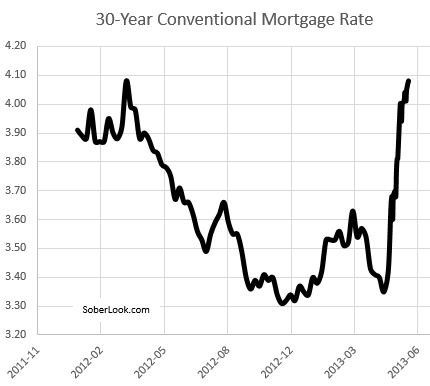
So far the only effect we are seeing is a decline in refinance activity – which has always been volatile. The Purchase Index however continues to show elevated mortgage activity that results from house purchases.
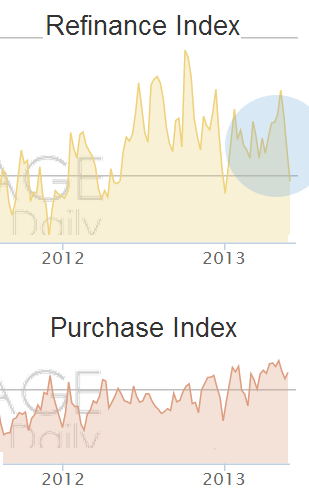
Source: Mortgage News Daily
The markets are also not anticipating the mortgage rate increases to have a major impact on the housing sector. Homebuilder shares, having taken a bit of a beating in recent days, are still massively outperforming the broader indices.
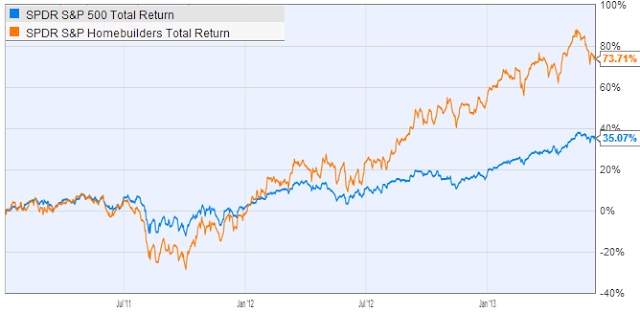
Source: Ycharts
Some analysts are warning however that if the 30-year mortgage rate rises above 4.5%, all bets are off and the housing market will begin to feel the effects.
Tuesday, June 11, 2013
Washington Still a Problem
The market has definitely benefited this year from a lack of headlines out of Washington regarding policy or legislative actions. Over the last couple of years, it seems as though every time policy or legislative related issues make headlines, it is pretty much a guarantee that it will have a negative impact on stock prices.
But just because Washington has been out of the headlines and having little impact on the market, don't think that it is no longer acting as a weight on small businesses. A case in point is today's NFIB report on small business optimism. Although the overall headline reading was stronger than expected (94.4 vs. 92.1), businesses still feel that policies coming out of Washington are the biggest threat to the success of their operations.
 In each month's survey, small business owners are asked what is the number one problem they are facing from a business perspective. In the table to the right we highlight the results of this month's survey, and the results are an embarrassment. Normally when you start a business, the main issue is whether or not you will have enough revenues to support your business and yourself. In this month's survey, though, only 16% of the small business owners that were surveyed cited Poor Sales as their number one problem, which ranks third on the list.
The two problems cited by small business owners more than any others were Taxes (24%) and Government Requirements & Red Tape (23%). On a combined basis, 47% of all small business owners believe that policies out of the government are the biggest problem they face, and those two problems outnumber Poor Sales by a margin of nearly three to one!
In the chart below, we show how the combined problems of Taxes and Government Requirements & Red Tape (Washington) have historically compared to Poor Sales as the number one problem facing small businesses. As shown in the chart, Washington has steadily become a larger and larger problem over the last five years, and while Poor Sales saw a spike leading up to and during the recession, it has been steadily declining since 2010. So far this year, this has not been an issue facing the markets, but that doesn't mean it will not become an issue once again in the future.

Subscribe to:
Posts (Atom)